How to Read a Japanese Auction Sheet
A plain-English guide to Japanese auction sheets: overall grades, interior grades, body-map damage codes, mileage marks and what a sheet can't tell you.
On this page
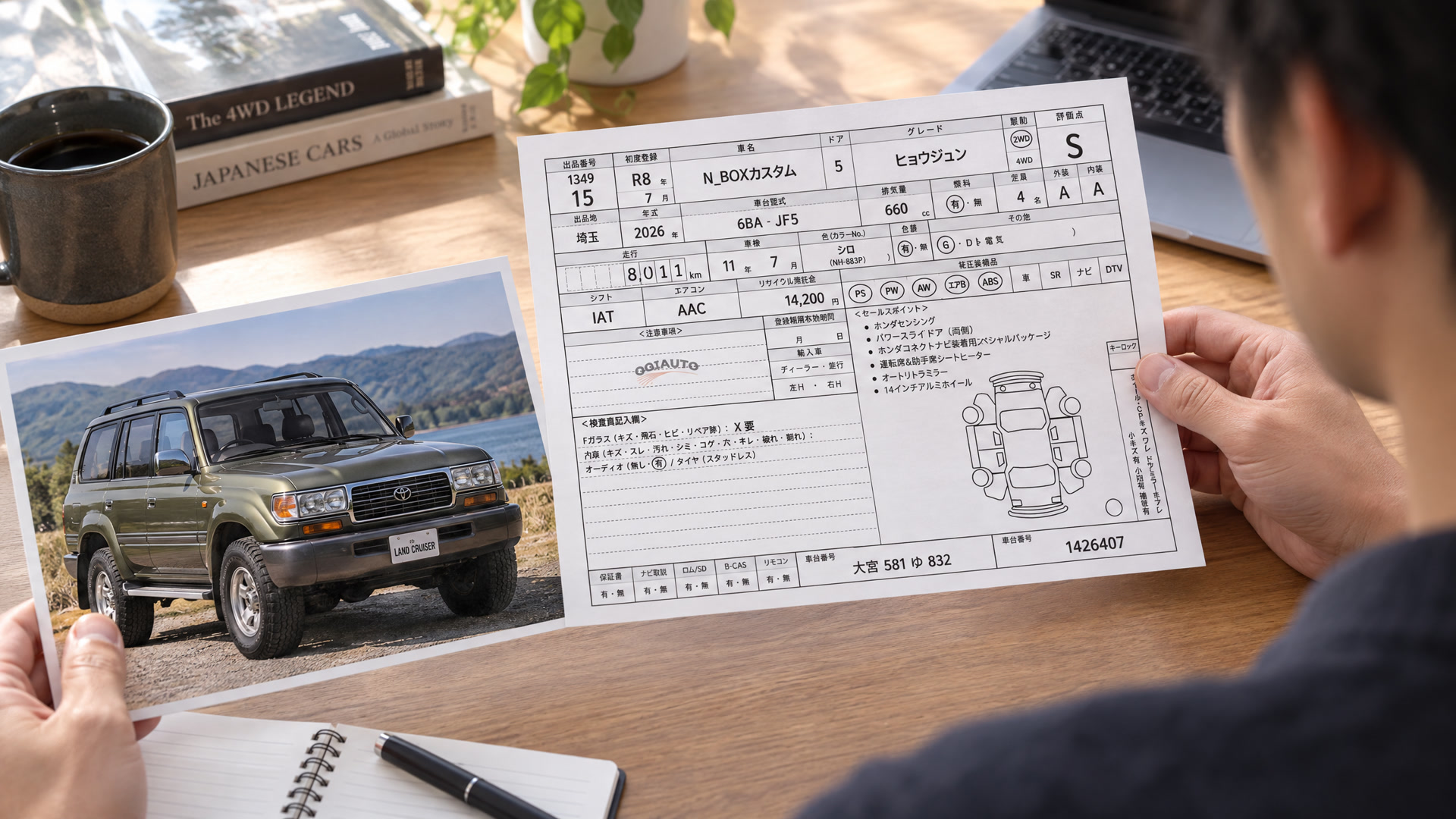
Every car at a Japanese auction comes with an inspection sheet written by the auction’s own inspector.
When you buy from Japan, you don’t get a test drive. You decide from the auction sheet, the photos and an inspection. That makes the sheet the most useful document you will see before you bid, if you know how to read it.
The parts of a sheet
Most sheets have the same sections:
- Header: model, model code, year of first registration, engine size, transmission, mileage, colour and the lot number.
- Overall grade: one number or letter for the whole car, relative to its age.
- Interior grade: a letter for the cabin.
- Seller’s points: equipment and selling points, written by the seller.
- Inspector’s notes: damage, repairs, smells, warning lights. This is the independent part.
- Body map: a drawing of the car with a code at every mark the inspector found.
What the overall grades mean
| Grade | Usually means |
|---|---|
| S, 6 | Nearly new |
| 5 | Near perfect. Rare on older cars |
| 4.5 | Excellent for its age |
| 4 | Above average, light wear |
| 3.5 | The most common grade. Read the notes closely |
| 3 | Visible wear or faults. Project territory |
| 2 and 1 | Major problems: rust holes, flood or fire damage, heavy modification |
| R, RA | Repaired accident damage, from minor to major. Not a salvage title |
| 0, *** | Ungraded. Often modified, damaged or not inspected. High risk |
Grades vary a little between auction groups and inspectors. Use the grade to rule cars out, then read the notes.
The interior is graded with a letter, usually from A (best) to E. A car can have a good overall grade and a tired interior, so check both.
Damage codes on the body map
| Code | Means |
|---|---|
| A | Scratch |
| U | Dent |
| B | Dent with a scratch |
| W | Wavy panel or a repair you can see |
| S | Rust |
| C | Corrosion |
| P | Paint marks or damage |
| Y | Crack or hole |
| X | Panel needs replacing |
| XX | Panel already replaced |
A number after the letter shows size: 1 is small, 3 is large. A2 is a medium scratch. U3 is a big dent.
Mileage marks
A mark next to the mileage, such as a star, means the auction could not verify the reading. Treat that car’s odometer as unknown.
Seller’s points versus inspector’s notes
The seller’s points are sales copy. The inspector’s notes are the independent part. When the two disagree, believe the inspector.
What a sheet can’t tell you
- The inspection is quick, and the car is only driven at low speed in the yard. Gearbox and suspension faults can hide.
- Rust underneath is easy to miss.
- Claims for faults the sheet missed have short deadlines and usually aren’t accepted on cars over about 10 years old.
That is why the sheet is a starting point, not the whole answer.
Why a full translation matters
Machine translation misses handwritten notes and auction shorthand. We translate the whole sheet into plain English for you, every line, and explain what it means for the car. Where location and timing allow, our auction inspector also looks at the car on the day.
Where to go next
The auction sheets chapter of our import guide includes a sample sheet translated line by line. For how bidding works, read the auctions chapter.
Found a car you like? Send us an inquiry and we’ll go through its sheet with you before you bid.
Thinking about a car from Japan?
Our free import guide walks you through every step, from the 25-year rule to registering the car in your state.