

01How importing a car from Japan works
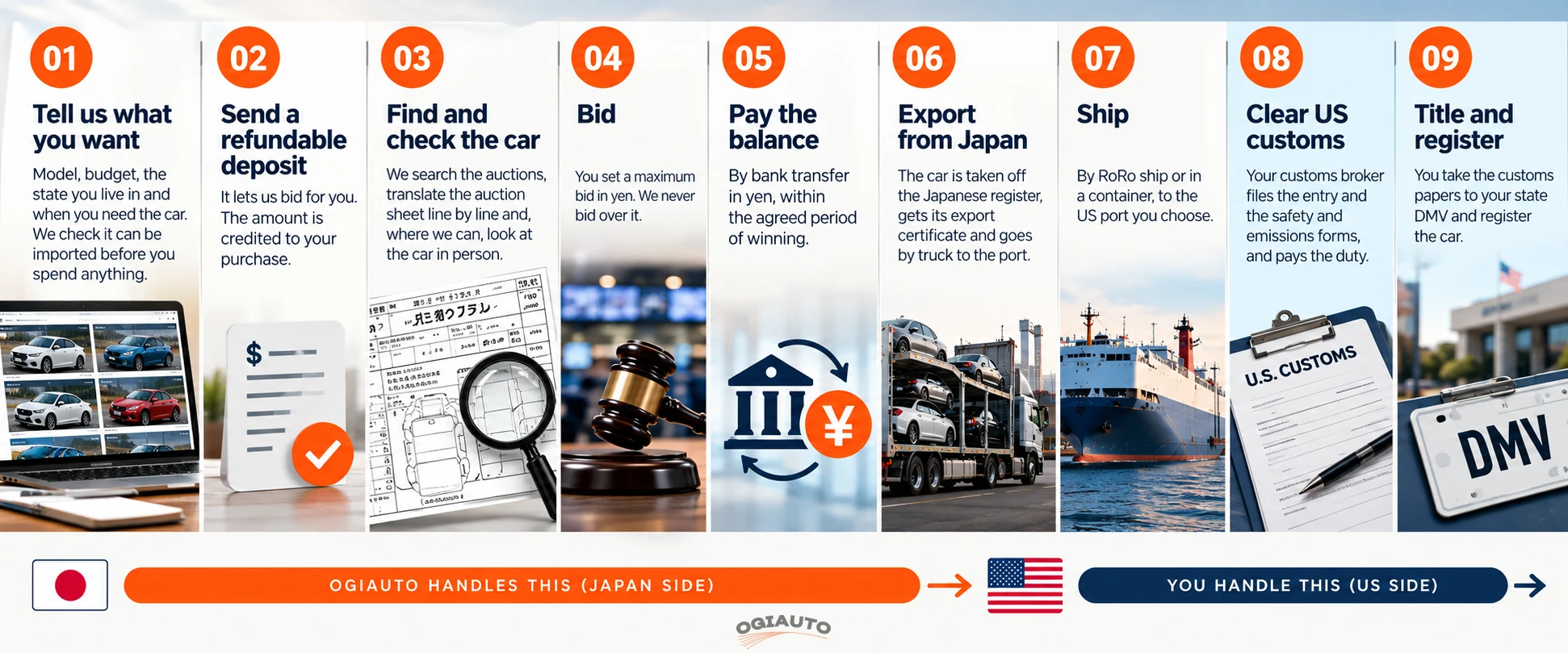
Importing a car from Japan takes nine steps. OgiAuto handles the Japan side. You, usually with a US customs broker, handle the US side.
- 01
Tell us what you want
Model, budget, the state you live in and when you need the car. We check it can be imported before you spend anything.
- 02
Send a refundable deposit
It lets us bid for you. The amount is 10% of the expected total FOB cost or ¥120,000, whichever is greater, and it's credited to your purchase.
- 03
Find and check the car
We search the auctions, translate the auction sheet line by line and, where we can, look at the car in person.
- 04
Bid
You set a maximum bid in yen. We never bid over it.
- 05
Pay the balance
By bank transfer or Wise transfer in yen, within 7 days of the invoice.
- 06
Export from Japan
The car is taken off the Japanese register, gets its export certificate and goes by truck to the port.
- 07
Ship
By RoRo ship or in a container, to the US port you choose.
- 08
Clear US customs
Your customs broker files the entry and the safety and emissions forms, and pays the duty.
- 09
Title and register
You take the customs papers to your state DMV and register the car.
How long it takes: usually two to three months from winning the car to collecting it at a US port. Most of that is waiting for papers and ships, not work on your side. Chapter 11 breaks the timeline down.
Who this guide is for
First-time importers who want to understand every step before they commit, and buyers who have done it before and want a checklist. It covers importing into the USA. Canada, Australia and the UK have different rules.
02Why buy a car from Japan
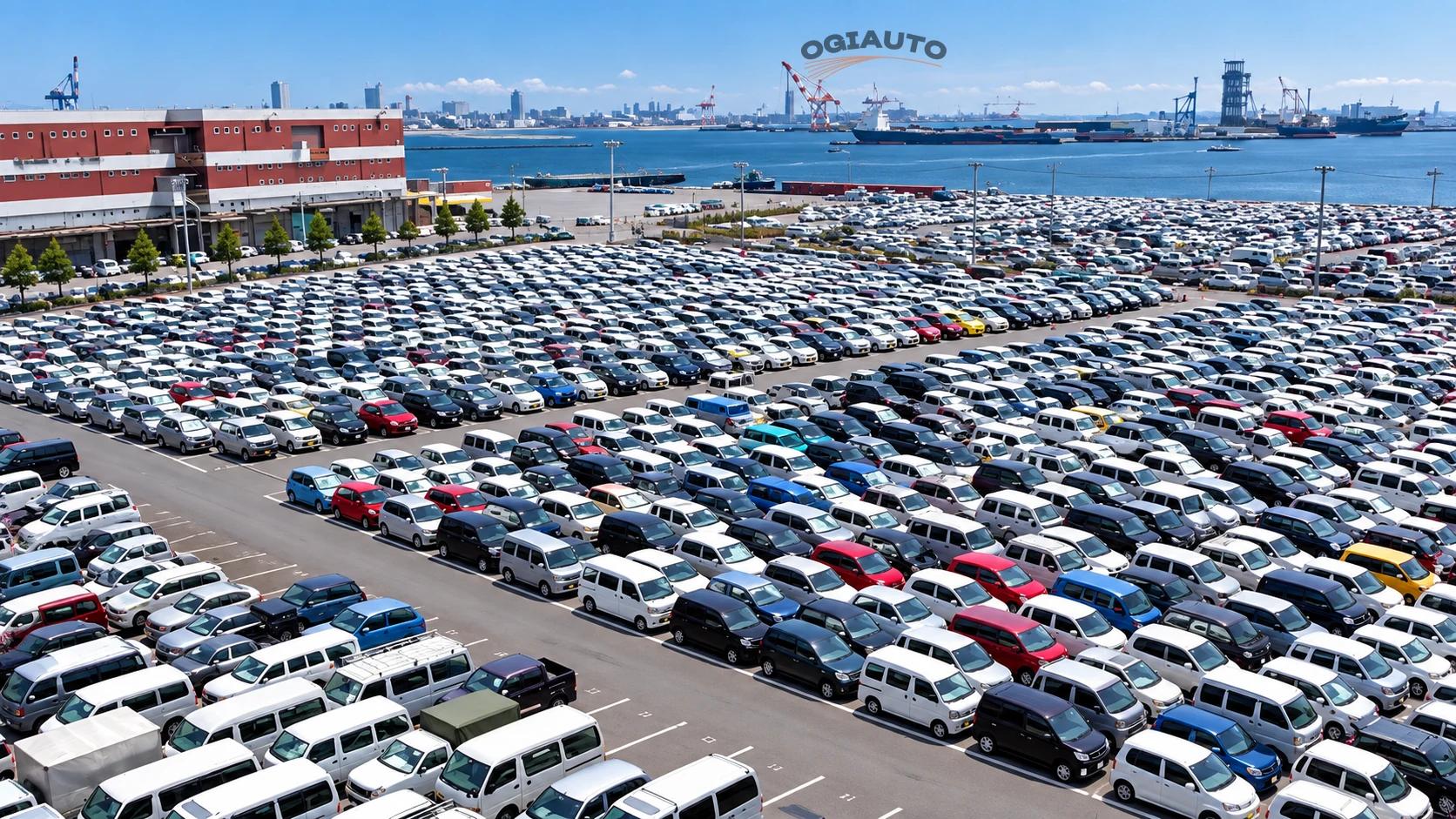
Japan sells cars that never came to the US, and they usually have lower mileage and better care than a car the same age at home. There are trade-offs too.
- Low mileage. Many people in Japanese cities commute by train, so cars cover fewer miles a year.
- Looked after. Japan's roadworthiness inspection, called Shaken, makes older cars expensive to keep on the road. Many reach the used market early and in good order.
- Cars you can't buy at home. Many Japanese-market models and trims were never sold in the US.
- Wholesale prices. Most used cars in Japan change hands at dealer-only auctions. Buying there through an agent cuts out a layer of resellers.
Some examples from our own listings: the Toyota Crown Majesta, the Toyota Celsior (sold abroad as the Lexus LS400, with Japanese-market details), and kei trucks such as the Daihatsu Hijet. See the cars.
The trade-offs
- Right-hand drive. Every Japanese-market car has the steering wheel on the right. Most drivers adjust quickly; passing slow traffic and drive-throughs take practice.
- Paperwork and waiting. Expect two to three months and a handful of forms. This guide covers all of them.
- Parts. Some Japanese-market parts have to come from Japan. We can source them for you after you buy.
- No test drive. You decide from the auction sheet, the photos and our inspection, not a drive around the block.
03Is the car legal to import? The 25-year rule
As of October 2026 · Reviewed by [broker to verify]
A car that is 25 years old or more can come into the US without meeting US safety standards. Newer Japanese-market cars usually can't be imported in any practical way.
The safety rule (NHTSA)
US safety standards don't apply to a vehicle that is 25 or more years old (49 CFR 591.5). NHTSA counts the age from the month and year the car was built. You declare it in box 1 of form HS-7, with the date of manufacture.
Example: a car built in March 2001 becomes eligible in March 2026. One built in November 2001 has to wait until November 2026.
The emissions rule (EPA)
EPA's exemption starts earlier, at 21 years, counted by calendar year (year of import minus year of manufacture), for cars in their original, unmodified configuration. It is code E on EPA form 3520-1. Gasoline cars built before 1968 fall outside EPA's import rules altogether. Because the safety rule still needs 25 years, 25 is the number that matters in practice.
Build date or first registration?
Japanese papers usually show the date the car was first registered, which can be months after it was built. The safety rule uses the build date. Check the manufacturer's plate on the car and keep proof of its age. Where there is no label, NHTSA accepts documents such as the original sales invoice or a registration record.
Cars under 25 years old
A car under 25 that was never sold in the US has to go through a Registered Importer, be modified to meet US safety standards, and be covered by a DOT bond of 150% of its value. If it isn't brought into line, it must be exported or destroyed. For most Japanese-market cars that's impractical or impossible.
The alternative is to buy the car now and store it in Japan until it turns 25. See chapter 10.
Show or Display
A narrow exemption for cars of historical or technological importance, approved by NHTSA case by case. Road use is capped at 2,500 miles a year. Very few cars qualify.
Federal rules first, then your state
Passing the federal rules doesn't mean you can register the car where you live. California has its own emissions rules, and several states restrict kei trucks. Read chapter 13 before you buy.
04Three ways to buy
Auction gives you the most choice and the best prices. Our stock is quicker and lower risk. By request is for one specific car you can't find.
| Auction | OgiAuto stock | By request | |
|---|---|---|---|
| Choice | The whole Japanese market, every week | The cars we have listed | Whatever we can find for you |
| Price | Wholesale, set by bidding | Fixed price, FOB Japan | Depends on where we find it |
| Risk | You decide from the auction sheet and photos | Already bought and checked | Depends on the source |
| Speed | You can bid this week | Ready to ship | Can take weeks |
| Best for | Most buyers | First-timers who want certainty | Rare or very specific cars |
Our current cars are on the home page. Sold cars stay listed, so you can see what we have found before. We don't show the prices they sold for.
Buying outside the auctions
Some cars never go to auction: limited editions, classics with full service history, or a car you spotted on a Japanese dealer site such as Goo-net or Carsensor. Send us the link. We contact the dealer, ask your questions in Japanese and negotiate. The final price for a dealer or private purchase is worked out case by case. It depends on where the car is, the cost of inspection, the seller's final price and inland transport from the seller's location. Contact us for a quote.
05How Japanese car auctions work
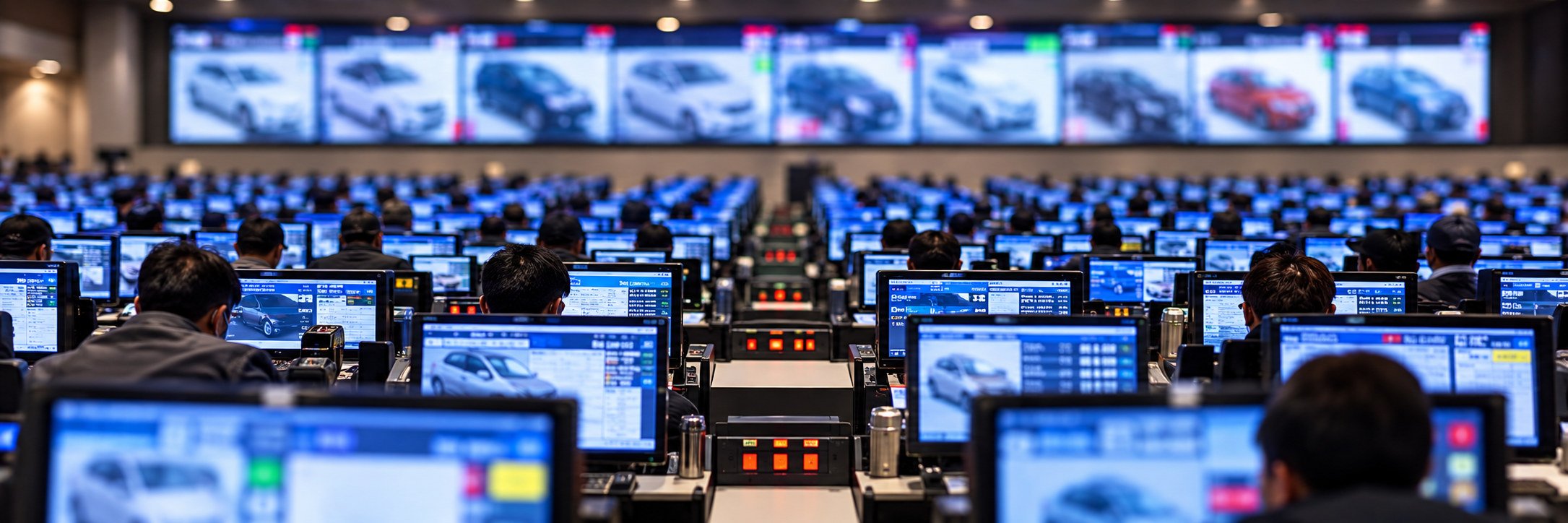
Japan's car auctions are for licensed dealers only. You can't bid yourself, so an auction member such as OgiAuto bids for you.
Most used cars in Japan are sold through auction houses where dealers bid on screens, one car at a time. The big groups include USS, TAA, JU, CAA, HAA, Arai and the online auction Aucnet. Roughly 40,000 cars are auctioned every week.
Proxy bidding: you set the maximum
You pick a car and tell us the most you will pay, in yen. We bid up to that amount and no higher. If the car sells for less, you pay the actual price.
Live bids and tender bids
Most cars sell in a live round that is over in well under a minute. Some auctions also accept sealed tender bids, placed in advance. Either way, the bidding happens fast, which is why your maximum has to be agreed beforehand.
Three possible results
- Bought. You won. We send the invoice and start the export.
- Sold. Someone else bid more. The final price still tells you what the market pays for that car.
- Passed. No bid met the seller's reserve price. We can sometimes negotiate with the seller after the auction.
Why we need your maximum in advance
Auctions run during the Japanese working day, which is the middle of the night across most of the US. We need your instruction in writing at least 2 hours before auction bidding time, so nobody is waiting on a reply while it sells.
06How to read a Japanese auction sheet
Every auction car comes with an inspection sheet written by the auction's own inspector. It is the most useful document you will see before you bid, if you know how to read it.
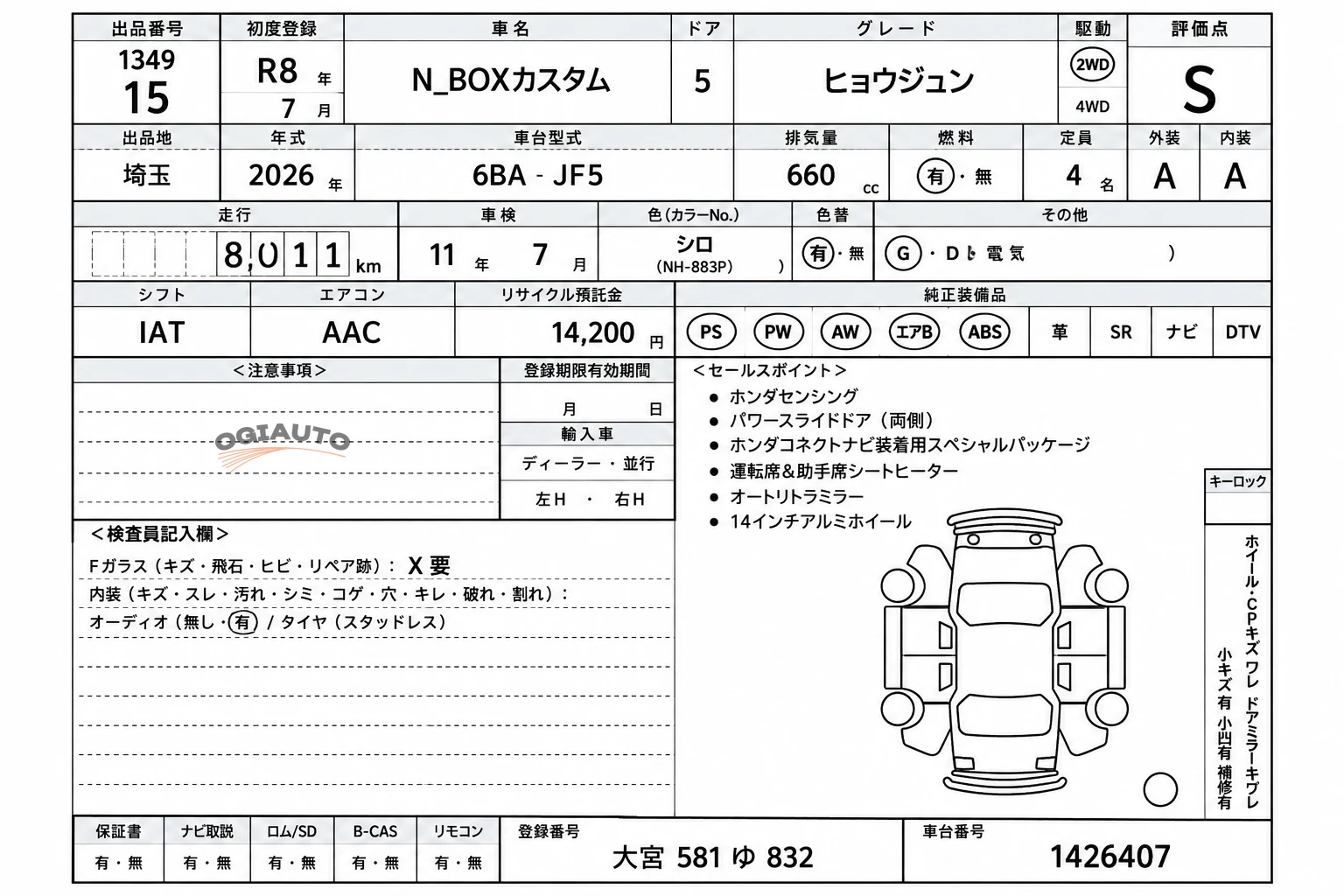
The parts of a sheet
- Header: model, model code, year of first registration, engine size, transmission, mileage, colour and the lot number.
- Overall grade: one number or letter for the whole car, relative to its age.
- Interior grade: a letter for the cabin.
- Seller's points: equipment and selling points, written by the seller.
- Inspector's notes: damage, repairs, smells, warning lights. This is the independent part.
- Body map: a drawing of the car with a code at every mark the inspector found.
Overall grades
| Usually means | |
|---|---|
| S, 6 | Nearly new |
| 5 | Near perfect. Rare on older cars |
| 4.5 | Excellent for its age |
| 4 | Above average, light wear |
| 3.5 | The most common grade. Read the notes closely |
| 3 | Visible wear or faults. Project territory |
| 2 and 1 | Major problems: rust holes, flood or fire damage, heavy modification |
| R, RA | Repaired accident damage, from minor to major. Not a salvage title |
| 0, *** | Ungraded. Often modified, damaged or not inspected. High risk |
Interior is graded with a letter, usually from A (best) to E. A car can have a good overall grade and a tired interior, so check both.
Damage codes on the body map
| Means | |
|---|---|
| A | Scratch |
| U | Dent |
| B | Dent with a scratch |
| W | Wavy panel or a repair you can see |
| S | Rust |
| C | Corrosion |
| P | Paint marks or damage |
| Y | Crack or hole |
| X | Panel needs replacing |
| XX | Panel already replaced |
Mileage marks
A mark next to the mileage, such as a star, means the auction could not verify the reading. Treat that car's odometer as unknown.
Seller's points and inspector's notes
The seller's points are sales copy. The inspector's notes are the independent part. When the two disagree, believe the inspector.
What a sheet can't tell you
- The inspection is quick, and the car is only driven at low speed in the yard. Gearbox and suspension faults can hide.
- Rust underneath is easy to miss.
- Claims for faults the sheet missed have short deadlines and usually aren't accepted on cars over about 10 years old.
Our translation of the sample sheet
| On the sheet | What it means | |
|---|---|---|
| 出品番号 | 1349 / 15 | Lot number |
| 出品地 | 埼玉 | Auction location: Saitama |
| 車名 / グレード | N_BOXカスタム / ヒョウジュン | Honda N-BOX Custom, standard grade |
| 初度登録 / 年式 | R8年7月 / 2026 | First registered July 2026 (Reiwa 8); model year 2026 |
| 車台型式 | 6BA-JF5 | Model code |
| 排気量 / 定員 / ドア | 660cc / 4 / 5 | 660cc engine (kei class), 4 seats, 5 doors |
| 駆動 | 2WD | Two-wheel drive |
| 評価点 | S | Overall grade S: nearly new |
| 外装 / 内装 | A / A | Exterior grade A, interior grade A |
| 走行 | 8,011 km | Mileage: 8,011 km (about 4,980 miles) |
| 車検 | 11年7月 | Shaken valid until July 2029 (Reiwa 11) |
| 色 / 色替 | シロ (NH-883P) / 有 | White, paint code NH-883P. Colour change marked 有 (yes): the car has been repainted a different colour. The paint code is usually left off when the colour has been changed, so a code on a sheet like this is worth asking us about |
| シフト / エアコン | IAT / AAC | Dash-mounted automatic; automatic climate control |
| リサイクル預託金 | 14,200円 | Recycling deposit paid in Japan: ¥14,200 |
| 純正装備品 | PS, PW, AW, エアB, ABS | Factory power steering, power windows, alloy wheels, airbags, ABS. No leather, sunroof, navigation or TV marked |
| セールスポイント | ホンダセンシング, パワースライドドア… | Seller's points: Honda Sensing safety system, power sliding doors on both sides, Honda Connect navigation package, heated front seats, auto-folding mirrors, 14-inch alloy wheels |
| 検査員記入欄 | Fガラス X要 | Inspector: windscreen needs replacing |
| オーディオ 有 / タイヤ (スタッドレス) | Audio fitted; winter (studless) tyres | |
| Side notes | ホイール・CPキズ ワレ, ドアミラーキズ… | Wheel and wheel-cap scratches and a crack, door-mirror scratches, small scratches, small dents, repairs present |
| 登録番号 / 車台番号 | 大宮 581 ゆ 832 / 1426407 | Japanese registration plate; chassis number |
07Buying smarter at auction
A few habits that get you a better car for the money.
- Look past the Shaken date. Cars with little Shaken time left are worth less to Japanese buyers, who would have to pay for the next inspection. You don't need Shaken in the US, so those cars can be good value.
- Know the calendar. March is the end of the Japanese financial year and one of the busiest times at auction, so there is more choice. Auctions close for a few days around Golden Week (early May), Obon (mid-August) and New Year.
- Read where an R-grade repair was. Some R-grade cars had one panel replaced after a minor knock. Walk away from damage to structural parts: chassis rails, inner panels, the radiator support, the floor of the trunk.
- Look at smaller auctions. Auctions far from Tokyo can have fewer bidders. The extra truck cost can be less than the price difference.
- Bid on several cars. Pick three or four that suit you and tell us to stop after the first win. You win more often without overpaying for one.
- Avoid round numbers. A maximum just above a round figure, say ¥1,020,000 rather than ¥1,000,000, can beat bidders who stop at the round figure.
- Don't lowball. Good cars rarely sell far below market. A very low winning price usually means a problem. We show you recent prices for the same model so you can set a realistic maximum.
Kei trucks
Small Japanese work trucks such as the Daihatsu Hijet, Suzuki Carry and Honda Acty. Easy to import once they are 25 years old, but each state decides whether they can use public roads. Read chapter 13 before you buy one.
Luxury sedans
The Toyota Crown Majesta, Celsior and Century were built for Japan and come well equipped. Many later cars have air suspension, so ask us about its condition before you bid.
4x4s and vans
Land Cruiser, Hilux Surf, Delica, Terrano: check underneath for rust, especially on cars from snowy regions. The inspector's notes and our photos of the underside matter more here than the grade.
08What it really costs
As of October 2026 · Reviewed by [broker to verify]
The car is only part of the bill. Here is every cost between the auction and your driveway, and who you pay each one to.
Our car prices are FOB Japan: the price covers the car up to the port in Japan. Shipping and US costs are extra.
Our fee
- Car price ¥10,000 to ¥1,000,000: ¥120,000
- Car price over ¥1,000,000: ¥120,000 plus 5% of the amount over ¥1,000,000. A ¥1,500,000 car carries a fee of ¥145,000.
The fee covers the pre-purchase consultation, examples of cars we have sold before, auction fees for the purchase, domestic bank transfers, export paperwork, Japanese customs clearance, booking the ship and freight forwarding. [Sam to confirm]
Every cost, line by line
| Item | Paid to | JPY | USD |
|---|---|---|---|
| The carThe hammer price. | The auction, through us | Varies | |
| OgiAuto service feeSee above. | OgiAuto | Varies | |
| Inland transport in JapanDepends on the auction's location. | Transport company, through us | [needs number] | |
| Ocean freightDepends on the car's size and how it ships. | Shipping line, through us | [needs number] | |
| Marine insuranceOptional, recommended. | Insurer | [needs number] | |
| Customs broker | Your broker | [needs number] | |
| Customs bond (single entry) | Surety, through your broker | [needs number] | |
| Import dutySee the duty section below. | US Customs | Varies | |
| Merchandise Processing Fee0.3464% of the car's value, within these limits (from 1 October 2026). | US Customs | ≈ $34.58–$670.86 | |
| Harbor Maintenance Fee0.125% of the car's value. | US Customs | Varies | |
| Port and terminal charges | Port or terminal | [needs number] | |
| Trucking from the port | Trucking company | [needs number] | |
| Title, tax and registration | Your state | Varies |
US import duty
The base rates are 2.5% for passenger cars and 25% for trucks and cargo vans, kei trucks included. Vehicles built at least 25 years before the year they enter the US are exempt from the 2025 Section 232 auto tariffs.
In July 2026 a new Section 301 tariff on goods from Japan took effect. As we read the tariff schedule, it brings a 25-year-old Japanese car to 12.5% in total, while trucks stay at 25%. [broker to verify]
Gas guzzler tax
The IRS says someone who imports a car for personal use may owe the federal gas guzzler tax, which covers 1980 and later cars below a fuel-economy threshold. [broker to verify]
A worked example (Japan side)
| Item | Paid to | JPY | USD |
|---|---|---|---|
| The car | ¥1,500,000 | ||
| OgiAuto service fee | ¥145,000 | ||
| Inland transport in Japan | [needs number] | ||
| Ocean freight | [needs number] | ||
| Marine insurance | [needs number] | ||
| Japan side, before US costs | [needs number] | ||
09Paying safely
You pay in Japanese yen by bank transfer or Wise transfer: a refundable deposit before we bid, the balance after you win.
The deposit
Before we bid, you send a refundable deposit of 10% of the expected total FOB cost or ¥120,000, whichever is greater. It's credited to your purchase. If you decide not to buy, we refund it minus bank charges.
Paying for the car
When you win, we send an invoice for the car, our fee and inland transport. Pay in full within 7 days of the invoice. Late payments carry a fee of 10% per week, and if nothing is paid within 30 days we cancel and resell the car. Export starts once the money has cleared.
Pay in yen, by bank transfer or Wise transfer. Wise is often cheaper than a bank wire, because its exchange rate is closer to the market rate.
What we don't offer
- Financing. Talk to your own bank or credit union.
- Letters of credit.
Ask for the auction invoice
The auction's own invoice shows the real hammer price. Ask us for it and compare it with ours. Any exporter you trust should agree to show it.
10From auction to port: export from Japan
After you pay, the car comes off the Japanese register, gets an export certificate and goes by truck to the port. We handle all of it.
- 01
Papers from the seller
The auction passes on the car's registration papers. This can take a couple of weeks.
- 02
De-registration and export certificate
The car is taken off the Japanese register and issued an export certificate. You need this certificate and its English translation to title the car in the US. It can't easily be replaced if lost, so keep it safe.
- 03
Inland transport
A truck takes the car from the auction to the port. The price depends on where the auction is, and is higher for very low, oversized or non-running cars. [needs number]
- 04
Optional work in our workshop
Before shipping we can service the car, change the timing belt, fix the clutch or convert the speedometer from km/h to mph. Our shop rate is ¥12,500 an hour plus parts.
- 05
Booking the ship
We book RoRo or container space to the US port you choose. See chapter 11.
Storage
Storage is free for 30 days after payment, then ¥1,000 per day. If your car isn't 25 years old yet, it can wait in Japan until it is, through our sister company JPD Japan.
11Shipping to the US
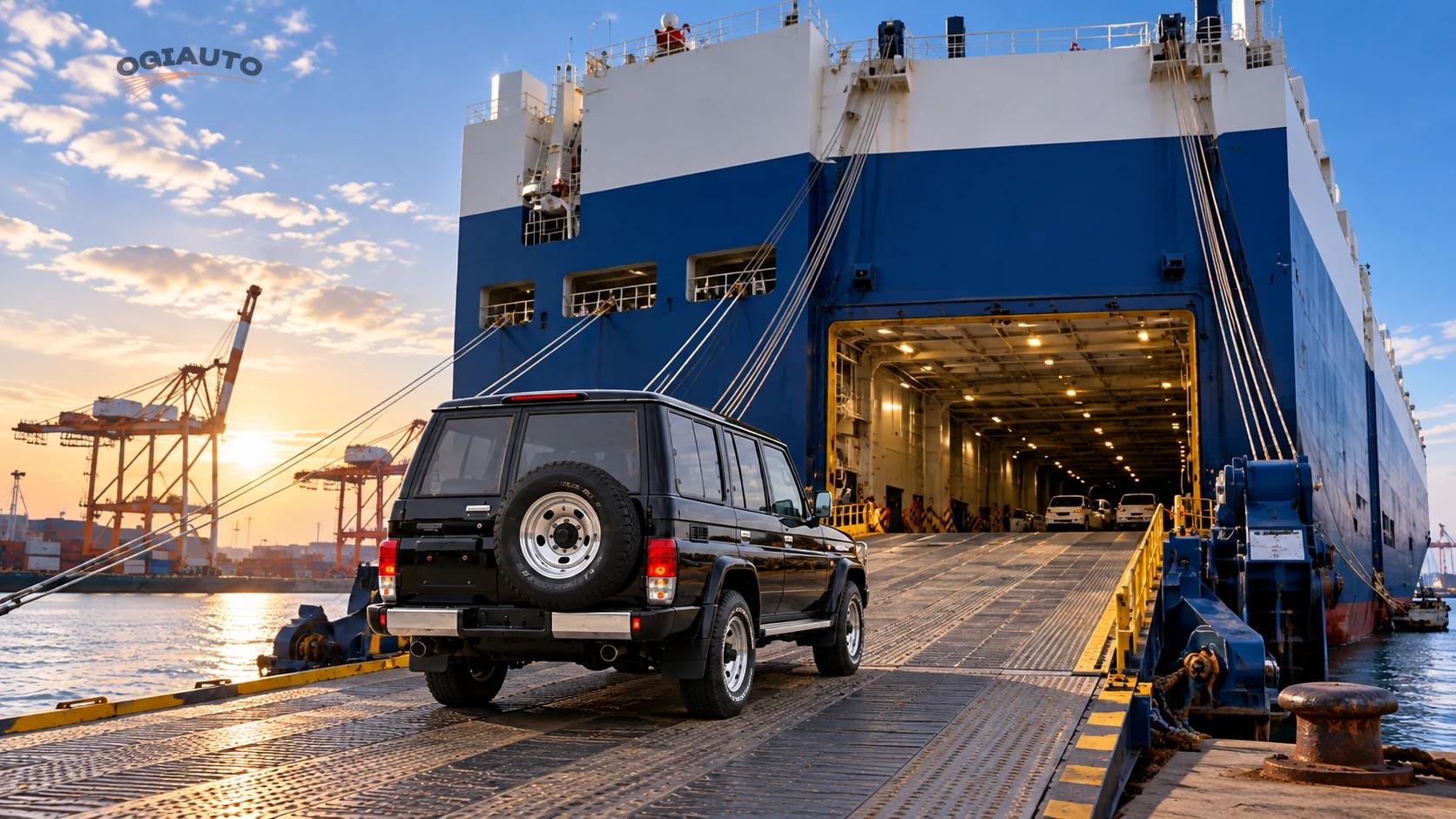
Most cars cross the Pacific on a RoRo car carrier. Containers suit non-running cars, valuable cars and cars shipped with parts.
| RoRo | Container | |
|---|---|---|
| How it works | The car is driven onto a car-carrying ship and parked on a deck | The car is strapped inside a steel container |
| Cost | Usually cheaper for one running car | Usually more per car; cheaper when several cars share |
| Best for | Running cars | Non-running or high-value cars, several cars, cars shipped with parts |
| Loose parts | Only if the shipping line allows them | Easier to pack parts with the car |
Marine insurance
Insurance is optional, and we recommend it. Without it, damage or loss at sea is your risk.
How long it takes
- 01
Purchase to leaving Japan
Typically 3 to 5 weeks, mostly waiting for papers and the next ship.
- 02
At sea
Typically 2 to 5 weeks, depending on the US port.
- 03
US customs and pickup
Typically 1 to 2 weeks.
These are typical times, not promises. Shipping lines change schedules often; we tell you as soon as they do. [Sam to confirm]
Documents you receive
Sent to you before the ship arrives
Bill of lading, or a surrendered or electronic releaseOgiAuto
Your broker needs it before the ship arrives.
Export certificate with English translationOgiAuto
Needed for customs and to title the car.
Our invoiceOgiAuto
And the original auction invoice, on request.
12US arrival: customs, forms and pickup
As of October 2026 · Reviewed by [broker to verify]
When the car reaches the US, three agencies need paperwork: US Customs (CBP), the safety regulator (NHTSA) and the EPA. A licensed customs broker handles most of it for you.
What a customs broker does
- Files the Importer Security Filing before the car is loaded in Japan.
- Arranges the customs bond.
- Files the entry with CBP, with the HS-7 and EPA 3520-1.
- Pays the duty and fees for you, then bills you.
- Tells you when and where to collect the car.
As the owner you can file the entry yourself, but CBP officers can't do it for you, and one mistake can hold the car at the port. Most first-time importers use a broker. [Sam to confirm]
The four forms
ISF
Importer Security Filing
US Customs and Border Protection
- Who files it
- Your broker.
- When
- No later than 24 hours before the car is loaded on the ship in Japan. RoRo cargo needs one too.
Late or wrong filings can cost $5,000 each, so give your broker the shipping details early.
Official pageCBP 7501
Entry Summary
US Customs and Border Protection
- Who files it
- Your broker, or you as the owner.
- When
- When the car arrives.
Shows the car's value, the duty and the fees paid. Keep a stamped copy: your DMV will ask for it.
Official pageHS-7
Declaration for imported vehicles
NHTSA (safety)
- Who files it
- Your broker, with your details.
- When
- At entry.
Box 1 declares the car is 25 or more years old, with its date of manufacture.
EPA 3520-1
Declaration for imported vehicles and engines
Environmental Protection Agency
- Who files it
- Your broker, with your details.
- When
- At entry.
Code E: at least 21 years old and in original, unmodified configuration.
Official pageCustoms bond
A car worth more than $2,500 goes through a formal entry, which needs a customs bond. Private buyers usually buy a single-entry bond through their broker.
Documents your broker will ask for
Bill of ladingOgiAuto
Export certificate with English translationOgiAuto
Invoice or bill of saleOgiAuto
Proof of the build dateOgiAuto
See chapter 3.
HS-7 and EPA 3520-1Your broker
Your ID and contact detailsYou
Collecting the car
Once CBP releases the car, you or a trucking company collect it from the port or terminal. Terminals charge storage after a few free days, so arrange pickup before the ship arrives. [broker to verify]
What can go wrong
- The car is under 25 by build date. It can be refused. Check the month, not just the year.
- A late or missing ISF. Penalties and delays.
- Papers that don't match. The chassis number on the car must match the export certificate and the bill of lading.
- A changed engine. It can affect the EPA exemption.
13Title and register in your state
As of October 2026 · Reviewed by [broker to verify]
Customs makes the car legal to import. Registering it is up to your state, and every state is different.
What most states ask for
- Customs papers stamped or endorsed by CBP, usually the CBP 7501.
- The HS-7 and EPA 3520-1.
- The Japanese export certificate, often with an English translation.
- The bill of sale or invoice.
- In many states, an inspection that checks the VIN or chassis number.
California
California has no 25-year exemption from its own emission rules. Gasoline cars from model year 1975 or earlier don't need smog checks. A 1976 or newer imported car must meet California's standards, which the DMV says can be very costly or impossible. Talk to the California DMV and CARB before you buy.
Kei trucks and kei cars
A 25-year-old kei truck can enter the US. Whether it can use public roads is up to your state, and the rules keep changing:
- Texas lets you title and register miniature vehicles 25 years old or more (since June 2025).
- Rhode Island doesn't allow new registrations of kei cars or kei trucks.
- Georgia won't title or register kei vehicles.
- New York won't register them without proof they meet federal safety and emission standards.
- Maine, Pennsylvania and others have debated changes. [broker to verify]
Insurance
Get an insurance quote before the car arrives so you can drive it home. Insurers may ask for the chassis number and photos.
14Avoiding scams
Most exporters are honest. The ones that aren't use a small set of tricks, and each has a simple check.
Tricks to watch for
- An inflated hammer price. The exporter says the car sold for more than it did and keeps the difference. Check: ask for the auction's original invoice.
- Fees nobody explains. Paperwork, inspection or postage charges that appear late. Check: get every fee in writing before you send a deposit.
- Marked-up freight. Ocean freight quoted far above what the shipping line charges. Check: ask what the freight price is based on.
- Rolled-back odometers. Most tampering happens after the auction, at the exporter. Check: compare the mileage on the original auction sheet with the car when it arrives.
- A changed bank account. A fake email asks you to pay a new account. Check: call the exporter on a number you already have. See chapter 9.
- A price that's too good. A 25-year-old sports car listed far below recent auction prices often doesn't exist.
How to check an exporter
Before you send any money
A registered Japanese company with a real address
A used-goods dealer licence (古物商) number
Willing to show the original auction sheet and invoice
Real people who answer your questions before you pay
15Glossary
Words you will meet on auction sheets and US customs forms.
- Auction sheet
- The inspection report for a car going to auction: its grade, plus a drawing of the car marking every ding, scratch, dent, rust spot and repair. See chapter 6.
- Bill of lading (B/L)
- The shipping line's receipt and title document for your car at sea. Your broker needs it to clear customs.
- CBP Form 7501
- The US Customs entry summary for your car. Your broker files it.
- Chassis number車台番号shadai bangō
- The Japanese equivalent of a VIN, stamped on the car and printed on its papers.
- Customs broker
- A licensed US professional who files the customs paperwork and pays the duty for you.
- EPA Form 3520-1
- The emissions declaration for an imported vehicle. See chapter 12.
- Export certificate輸出抹消仮登録証明書yushutsu masshō kari tōroku shōmeisho
- The Japanese document that proves the car was taken off the register for export. You need it, with a translation, to title the car.
- First registration初度登録shodo tōroku
- The date the car was first registered in Japan. It can be later than the date it was built.
- FOB
- Free on board: the price covers the car up to the port in Japan. Shipping and US costs are extra.
- Hammer price
- The price the car sold for at auction.
- HS-7
- The NHTSA safety declaration for an imported vehicle. See chapter 12.
- ISF
- Importer Security Filing: details of the shipment sent to US Customs before the cargo is loaded. Your broker files it.
- Kei car軽自動車kei jidōsha
- Japan's smallest class of car and truck, with an engine of 660cc or less.
- Model code型式katashiki
- Toyota's UZS186, for example. It identifies the exact version of a car.
- Proxy bid
- A bid placed for you by an auction member, up to the maximum you set.
- R / RA grade
- A car with repaired accident damage. It is not a salvage title.
- RoRo
- Roll-on/roll-off: a ship that cars are driven onto and off.
- Shaken車検shaken
- Japan's roadworthiness inspection. It doesn't apply in the US.
16Common questions
Short answers to what US buyers ask us most.
Can I import a car that isn't 25 years old yet?
Not as a normal road car. You can buy it now and store it in Japan until it turns 25, then ship it. See chapter 3.
Do I need a customs broker?
You can file the paperwork yourself, but most first-time importers use a broker. See chapter 12.
Can I see the car before I buy?
Only if you are in Japan. We can look at it for you where the auction location and timing allow. A detailed inspection report costs ¥20,000.
What if the car arrives with a problem the sheet didn't mention?
Auction claims have short deadlines and are rarely accepted on cars over about 10 years old. That's why we translate the sheet line by line and inspect in person where we can.
Is a right-hand-drive car a problem in the US?
Right-hand drive doesn't stop you importing a car. The 25-year rule is what matters. Ask your state DMV about anything state-specific.
How much will the car cost in total?
See the line-by-line breakdown in chapter 8.
Do you work with dealers?
Yes. We work with resellers and can set up an account for regular buyers. Tell us roughly how many cars you buy a year.
How do I start?
Message us on WhatsApp or send an inquiry with the model, your budget and your state. We'll tell you if it can be imported and what it's likely to cost.
Ready to find your car?
Tell us what you are looking for. We reply on WhatsApp or by email.